Table of Contents
ToggleTanzania Culture Safaris: Discover the Soul of Tanzania
Experience Tanzania beyond the safari vehicle.
Tanzania is one of Africa’s most extraordinary destinations—not only because of its legendary wildlife, spectacular national parks, and dramatic landscapes, but because of the people, traditions, languages, history, food, craftsmanship, beliefs, and living cultures that give the country its unique character.
From the communities living around the great northern safari landscapes to the ancient cultural traditions of the coast and islands, Tanzania offers travelers the opportunity to discover a country that is far richer than the classic image of an African wildlife safari. A Tanzania culture safari takes you beyond simply seeing Tanzania and gives you the opportunity to understand it.
You can meet people whose lives and traditions have evolved alongside the landscapes you are exploring, listen to stories passed down through generations, discover traditional knowledge of nature and wildlife, experience local food and craftsmanship, and gain a deeper appreciation for the extraordinary relationship between communities, culture, conservation, and the land.
A Tanzania culture safari invites you to experience this deeper side of the country.
Instead of experiencing Tanzania only through game drives and famous wildlife destinations, a cultural safari opens the door to another dimension of the country—one centered on human connection, heritage, community, and authentic discovery. You may find yourself sitting with local hosts, learning about traditional ways of life, walking through a village with someone who knows the landscape intimately, discovering how traditional crafts are created, tasting food prepared using local ingredients, or listening to stories that reveal a perspective of Tanzania impossible to obtain from a conventional sightseeing experience.
These encounters can transform the way you understand the landscapes you visit, because you begin to see them not simply as wilderness but as places connected to generations of human history and cultural identity.
A Tanzania culture safari is more than a collection of cultural activities. It is an opportunity to experience the country through its people, traditions, stories, food, landscapes, and heritage. For international luxury travelers, this creates an especially rewarding form of travel: the freedom to experience meaningful cultural encounters while enjoying privacy, excellent accommodation, expert local guidance, refined cuisine, and carefully considered service.
For international luxury travelers, cultural safaris offer something particularly special: the opportunity to experience Tanzania intimately while enjoying exceptional comfort, privacy, and personalized service.
Luxury cultural travel allows you to enjoy the best of both worlds. You can spend time learning from communities and discovering traditions without sacrificing comfort or personal space.
After an immersive cultural experience, you can return to an elegant lodge, private safari camp, boutique retreat, or exclusive property where you can relax in beautiful surroundings, enjoy exceptional dining, and have time to reflect on what you have experienced. With private vehicles, knowledgeable guides, flexible schedules, and carefully selected accommodation, the journey can be designed around your interests rather than a rigid timetable.
The result is a sophisticated travel experience in which luxury becomes a way of enhancing cultural immersion rather than separating you from it.
This is Tanzania beyond the postcard.
The Tanzania many travelers first imagine is a spectacular one: endless Serengeti plains, elephants beneath baobabs, the Ngorongoro Crater, dramatic sunsets, and the extraordinary spectacle of wildlife moving across the landscape.
But behind those iconic images is another Tanzania—one of communities, languages, traditions, craftsmanship, cuisine, history, music, storytelling, and everyday life. Cultural safaris allow travelers to move beyond the familiar postcard and encounter the people and traditions that give these landscapes meaning. They reveal a Tanzania that cannot be fully understood through photographs or game drives alone.
What Is a Tanzania Culture Safari?
A cultural safari in Tanzania is a journey centered on people and place.
It is a form of travel that combines Tanzania’s extraordinary natural environment with meaningful opportunities to learn about the people who live within and around these landscapes. Rather than treating culture as a brief stop between wildlife activities, a thoughtfully designed cultural safari makes human connection part of the journey itself. Depending on the destination and community, travelers may meet local families, community leaders, artisans, farmers, pastoralists, storytellers, cooks, guides, or other local hosts who can share knowledge from their own experiences. These encounters allow visitors to see Tanzania from perspectives that are rarely available through conventional tourism.
Rather than experiencing the country only through wildlife sightings and game drives, travelers are introduced to the communities, traditions, heritage, and everyday life that make Tanzania unique.
This approach can completely change the character of a safari. A game drive might introduce you to the wildlife of a particular landscape, while a cultural experience can introduce you to the people who understand that landscape through generations of lived experience. You may discover how communities use local plants, how food is produced, how traditional homes are constructed, how crafts are made, how stories are passed down, or how people have adapted their traditions to a changing world. These experiences create context around the destinations you visit and allow you to appreciate Tanzania not simply as a beautiful place, but as a living cultural environment.
Depending on the destination and community, a cultural experience may include:
- Meeting local families and community leaders
- Learning about traditional lifestyles and customs
- Discovering Indigenous knowledge of the natural environment
- Visiting traditional homes and community areas
- Experiencing local food and cooking traditions
- Learning about traditional arts and crafts
- Meeting skilled local artisans
- Discovering traditional music and dance
- Exploring historical and cultural sites
- Learning about pastoral and agricultural traditions
- Walking through villages and surrounding landscapes with local guides
- Hearing stories about Tanzania’s history and heritage
The precise experience depends on the community, region, season, and the way the experience has been developed with local people. That is important because Tanzania’s cultures are diverse and should never be reduced to one standardized experience. A meaningful encounter allows the community to determine how its traditions are shared while giving travelers enough time and context to understand what they are experiencing. Rather than moving quickly from one activity to another, luxury cultural safaris can give you the freedom to slow down, ask questions, observe details, and develop genuine appreciation for the people and places you encounter.
The most rewarding experiences are not about simply watching a culture from the outside.
They are about meeting people, asking questions, listening, and sharing meaningful moments.
That distinction is at the heart of responsible cultural travel. The greatest cultural experiences are often not the most elaborate or theatrical. They can be a conversation over tea, a demonstration by an artisan, a shared meal, an explanation of a traditional practice, a walk through a familiar landscape with a local guide, or a story told by someone whose family has lived in the region for generations. These moments create connection because they allow travelers to participate respectfully in an exchange rather than simply observing from a distance.
Tanzania: A Country of Extraordinary Cultural Diversity
One of the great attractions of Tanzania is its cultural diversity.
Tanzania is home to more than 120 ethnic groups, making it one of Africa’s most culturally diverse countries. Each community has contributed to the country’s broader identity through its own history, traditions, language, cuisine, craftsmanship, social structures, music, stories, and relationship with the natural environment. While some cultural traditions are well known internationally, many remain relatively unfamiliar to visitors, which makes cultural exploration particularly rewarding. Traveling through Tanzania can therefore feel like discovering many different cultural worlds within one country.
The country is home to more than 120 ethnic groups, each contributing its own traditions, histories, languages, customs, art, food, and perspectives.
This diversity means there is no single experience that can represent Tanzania as a whole. Northern Tanzania has cultural traditions shaped by pastoral communities and long relationships with wildlife and open landscapes. The Lake Eyasi region provides opportunities to learn about Indigenous heritage and traditional environmental knowledge. The central and southern regions have their own distinctive histories and cultural traditions, while the coast and islands reveal centuries of interaction across the Indian Ocean. Together, these communities form a cultural landscape as remarkable and varied as Tanzania’s geography.
From the Maasai communities of northern Tanzania to the Hadzabe around Lake Eyasi, from the Datoga people to the Swahili culture of the coast and Zanzibar, Tanzania offers travelers an extraordinary opportunity to discover many different expressions of African heritage.
The beauty of cultural travel is that these experiences do not have to be treated as separate from a luxury safari. They can be woven naturally into a broader journey through Tanzania, creating a richer understanding of the country. A traveler might experience pastoral traditions in the north, discover Indigenous knowledge around Lake Eyasi, learn about craftsmanship, and later encounter the Swahili heritage of the Indian Ocean coast. Each experience provides a different perspective, and together they create a much more complete picture of Tanzania.
There is no single “Tanzanian culture.”
There are many cultures, communities, histories, and traditions woven into one remarkable country.
That diversity is what makes a cultural safari so rewarding.
Rather than searching for one definition of Tanzania, cultural travel encourages you to appreciate its complexity. The country becomes a collection of voices, landscapes, traditions, and stories, each contributing something different to the experience. For travelers who value depth and authenticity, this cultural diversity provides an opportunity to return home with more than photographs—you return with a deeper understanding of a country and its people.
Maasai Culture in Tanzania
For many international travelers, the Maasai are one of the most recognizable cultural communities in East Africa.
Their distinctive clothing, beadwork, pastoral traditions, ceremonies, community structures, and close relationship with livestock and the surrounding landscape have become closely associated with northern Tanzania. Yet behind the internationally familiar image is a complex and evolving society whose traditions continue to interact with education, conservation, tourism, economic change, and modern life. A responsible cultural experience provides an opportunity to move beyond stereotypes and learn directly from community members about their lives, values, history, and contemporary experiences.
Their distinctive clothing, traditional ceremonies, pastoral lifestyle, crafts, and close relationship with livestock and land have become strongly associated with northern Tanzania.
Cattle and pastoralism have historically played an important role in Maasai society, shaping aspects of community life, identity, mobility, and social relationships. At the same time, Maasai communities are not frozen in a historical moment. Families and individuals today navigate modern education, healthcare, technology, changing economic opportunities, conservation initiatives, and tourism alongside longstanding traditions. Understanding this balance between heritage and change can make a cultural experience considerably more meaningful than simply observing traditional clothing or ceremonies.
But a meaningful Maasai cultural experience goes beyond photographs.
Photography can capture appearance, but meaningful cultural travel seeks understanding. A respectful visit creates space for conversation and learning rather than treating people as subjects. Travelers can gain insight into the realities of pastoral life, traditional knowledge, family structures, crafts, community relationships, and the changing relationship between people and wildlife. When these experiences are community-led and responsibly managed, tourism can become a channel for cultural exchange and economic opportunity.
With a responsible, community-based experience, travelers can learn about:
- Maasai pastoral traditions
- Family and community structures
- Traditional ceremonies and celebrations
- Cattle and livestock
- Traditional crafts and beadwork
- Indigenous knowledge
- The relationship between people, wildlife, and land
- The challenges facing modern pastoral communities
Each of these subjects can reveal a different part of Maasai life. Learning about pastoralism, for example, can help explain why cattle have such significance. Exploring beadwork can reveal the cultural meaning behind colors, patterns, and craftsmanship. Discussing conservation can demonstrate how communities interact with wildlife and protected landscapes. Listening to community members can also reveal how traditions are adapting as younger generations pursue education and new opportunities.
The best encounters are those in which local people have an active voice in how their culture is presented and shared.
This principle is essential to responsible cultural tourism. Communities should have agency over the experiences offered to visitors, and travelers should approach these encounters with curiosity, humility, and respect. When cultural experiences are created collaboratively, the result can be far more authentic and valuable for everyone involved. The traveler gains genuine insight, while communities can benefit economically and have greater control over how their heritage is represented.
For a luxury traveler, this creates an experience that feels personal rather than staged—an opportunity to meet people, exchange perspectives, and understand a way of life that has adapted to a changing Tanzania.
The appeal lies in the intimacy of the encounter. Instead of simply passing through a destination, you have the opportunity to pause, listen, and engage. A private guide can provide cultural context, explain local customs, and help create respectful interactions, while the community itself remains the primary source of knowledge. For discerning travelers, this combination of exclusivity, depth, and authenticity can make a cultural experience one of the defining moments of a Tanzania journey.
The Hadzabe: Indigenous Heritage Around Lake Eyasi
For travelers searching for a more unusual cultural experience, the Lake Eyasi region offers an entirely different perspective.
Located away from the most heavily visited wildlife destinations, Lake Eyasi provides a fascinating cultural dimension to northern Tanzania. The surrounding landscape is shaped by arid terrain, seasonal resources, traditional livelihoods, and communities with deep knowledge of their environment. A visit to the region can feel very different from the classic safari experience, offering travelers an opportunity to focus on human history, Indigenous knowledge, and the relationship between communities and their surroundings.
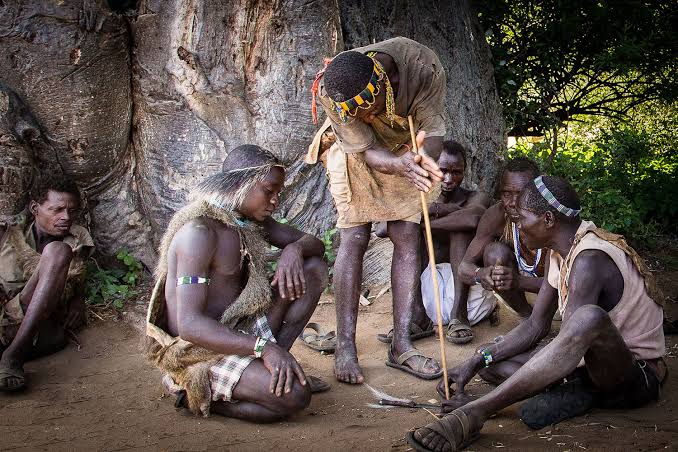
The Hadzabe are one of Tanzania’s Indigenous communities and are traditionally associated with hunting and gathering.
The Hadzabe have maintained distinctive cultural traditions and a profound knowledge of the local environment. Their traditional way of life provides a fascinating example of how human communities can develop detailed systems of knowledge around plants, animals, seasons, water sources, and landscapes. A respectful encounter can introduce visitors to aspects of this knowledge while also encouraging a broader understanding of Indigenous heritage and the pressures and changes affecting communities today.
Their knowledge of the environment is remarkable.
For generations, environmental knowledge has been fundamental to survival. Understanding seasonal changes, identifying plants, recognizing animal tracks, locating resources, and interpreting the landscape all require an intimate relationship with nature. For visitors from highly urbanized environments, encountering this level of environmental knowledge can be particularly powerful because it offers a radically different perspective on what it means to understand and depend upon a landscape.
A cultural encounter can introduce travelers to aspects of traditional life, including knowledge of wild foods, plants, tracking, hunting techniques, and the natural environment.
The value of the experience is not simply in watching a traditional skill being demonstrated. It is in understanding the knowledge behind the skill and the relationship between that knowledge and the surrounding environment. With appropriate local guidance, travelers may gain insight into how resources are identified, how landscapes are read, and how knowledge is passed between generations. Such experiences can be particularly meaningful when they encourage visitors to listen rather than assume that they already understand what they are seeing.
What makes the experience so fascinating is the relationship between people and landscape.
In many modern societies, nature can feel separate from everyday life. Around Lake Eyasi, the relationship between people and environment can be understood in a very different way. Landscape is not merely scenery; it can be a source of food, knowledge, movement, memory, identity, and survival. This perspective can add an entirely new dimension to a Tanzania safari.
The surrounding environment is not simply scenery.
It is a source of food, knowledge, history, identity, and survival.
For travelers accustomed to modern urban life, experiencing this perspective can be profoundly memorable.
A cultural encounter around Lake Eyasi can encourage reflection on how different societies understand resources, community, nature, and survival. It is precisely this ability to challenge assumptions and introduce new perspectives that makes cultural travel so powerful. The experience becomes more than another attraction visited during a safari—it becomes an opportunity to understand a different relationship between people and the natural world.
Datoga Culture and Traditional Craftsmanship
Tanzania’s cultural richness also lives in its craftsmanship.
Across the country, traditional skills are expressed through metalworking, weaving, carving, beadwork, basketry, pottery, textiles, jewelry, and other forms of craftsmanship. These skills are not merely decorative. They can represent practical knowledge, family traditions, economic activity, artistic expression, and cultural identity. Meeting artisans allows travelers to see the knowledge and effort behind objects that might otherwise be encountered only as souvenirs.
The Datoga people are particularly known for traditional metalworking and craftsmanship.
Datoga craftsmanship provides a fascinating window into the relationship between practical skills and cultural heritage. Traditional metalworking involves knowledge of materials, tools, heat, shaping, and technique, often developed through years of observation and practice. Seeing an artisan work can therefore reveal something much deeper than the finished object: it reveals a process of knowledge transfer and cultural continuity.
Visiting a Datoga community can provide an opportunity to see traditional skills being practiced and passed from one generation to another.
For a traveler, watching the process can be an intimate experience. You may see raw materials transformed through traditional techniques into objects with practical or cultural significance. More importantly, you can learn about the people behind the craft, the skills involved, and the role craftsmanship plays within community life. These encounters can create a stronger connection to Tanzania because they make cultural heritage tangible and understandable.
Watching an artisan work with metal, tools, and fire offers an intimate glimpse into the practical knowledge behind everyday objects.
The combination of fire, metal, tools, movement, and concentration creates an experience that is visually compelling but also intellectually fascinating. It demonstrates that cultural heritage is often preserved not in museums, but in skills practiced by living people. Every generation that learns a traditional craft contributes to keeping that knowledge alive.
These experiences remind travelers that cultural heritage is not only found in ceremonies and historical monuments.
It is also found in hands, skills, materials, and knowledge.
Cultural Experiences Around Ngorongoro
The Ngorongoro region is famous throughout the world for its spectacular crater and exceptional wildlife.
The crater is one of Tanzania’s most iconic destinations, but focusing exclusively on wildlife can mean overlooking the broader cultural landscape surrounding it. The wider Ngorongoro area has a rich human history and remains home to communities whose livelihoods, traditions, and experiences are closely connected to the surrounding environment. Understanding this human dimension can add considerable depth to a visit.
But the wider Ngorongoro landscape is equally fascinating from a cultural perspective.
The region illustrates the complex relationship between conservation, tourism, pastoralism, agriculture, wildlife, and community life. These different interests exist within the same landscape, creating a destination that is not simply a protected wilderness but a place where people, animals, ecosystems, and economic activities interact. Cultural experiences can help travelers appreciate these relationships rather than viewing the landscape through a single lens.
People and wildlife have shared this environment for generations, creating a remarkable landscape where conservation, pastoralism, agriculture, tourism, and traditional ways of life intersect.
This relationship is one of the most important stories in modern Tanzania. Conservation is not simply about protecting animals; it also involves understanding the communities living around protected areas and the ways tourism and conservation can affect local livelihoods. Learning about these realities can make a wildlife safari more meaningful because travelers begin to see conservation as a human story as well as an environmental one.
Cultural experiences in the region can help visitors understand:
- Traditional pastoral lifestyles
- Local agriculture
- Community relationships with the landscape
- Indigenous knowledge
- Conservation and community coexistence
- The history of the Ngorongoro area
These subjects provide context that cannot be gained from a game drive alone. A cultural guide or community host can explain how people use the landscape, what challenges they face, how traditions have evolved, and how conservation affects everyday life. For travelers interested in responsible tourism, these conversations can be among the most valuable aspects of a journey.
This creates an important context for the wildlife experience.
Instead of seeing the landscape only as a wilderness destination, travelers begin to understand it as a living cultural landscape.
That shift in perspective can change the entire safari experience. The animals remain extraordinary, but they are now part of a larger story involving people, history, land, conservation, and culture. This is one of the defining strengths of a well-designed Tanzania cultural safari.
The Swahili Culture of Tanzania
Tanzania’s cultural story extends far beyond the northern safari circuit.
The country’s cultural richness cannot be understood solely through its famous safari destinations. Along the mainland coast and across the islands of the Indian Ocean, travelers encounter the world of Swahili culture—a heritage shaped by centuries of movement, trade, migration, religion, maritime connections, and cultural exchange. This coastal dimension adds extraordinary depth to a Tanzania journey and demonstrates just how diverse the country really is.
Along the coast and across the islands of the Indian Ocean, travelers discover the extraordinary world of Swahili culture.
Swahili culture developed through centuries of interaction along the East African coast, where African communities interacted with Arab, Persian, Indian, and other Indian Ocean cultures. The result is a distinctive cultural heritage visible in language, architecture, food, music, religion, clothing, trade traditions, and everyday life. It is one of the most fascinating examples of cultural exchange anywhere in Africa.
Swahili heritage reflects centuries of interaction between African, Arab, Persian, Indian, and European influences.
This history can be experienced rather than simply read about. Travelers can explore historic architecture, taste coastal cuisine, visit markets, discover traditional crafts, walk through old neighborhoods, and speak with local people about the history of their communities. The experience demonstrates how geography can shape culture: the Indian Ocean was not a barrier but a highway connecting people and ideas across vast distances.
This history can be experienced through:
- Architecture
- Language
- Food
- Music
- Traditional clothing
- Coastal markets
- Historic towns
- Maritime traditions
- Religious heritage
- Spice cultivation
- Local craftsmanship
The richness of Swahili culture is particularly apparent in its architecture and food. Carved wooden doors, narrow streets, courtyards, markets, mosques, historic buildings, and waterfront spaces reveal layers of history. Coastal cuisine brings together spices, seafood, coconut, rice, and influences from across the Indian Ocean, creating flavors that are distinctly different from those encountered in the interior.
The island of Zanzibar is particularly famous for this cultural heritage.
Zanzibar provides one of the most compelling cultural extensions to a Tanzania safari. The island’s history as a major Indian Ocean trading center has left a visible legacy in its architecture, cuisine, language, markets, and traditions. Stone Town, with its narrow streets, historic buildings, carved doors, bustling markets, and waterfront atmosphere, offers travelers an immersive encounter with this layered history. Beyond Stone Town, spice farms, fishing communities, beaches, and rural villages reveal additional dimensions of island life.
Its historic Stone Town, narrow streets, carved wooden doors, markets, mosques, and waterfront traditions reveal a very different side of Tanzania from the open plains of the Serengeti.
The contrast is extraordinary. One moment you can be surrounded by the vastness of the African savannah; another, you can be walking through centuries-old coastal streets surrounded by the sounds, aromas, architecture, and rhythms of the Indian Ocean. This contrast makes Tanzania uniquely suited to travelers who want both wilderness and culture.
This contrast is one of the country’s greatest attractions.
From the savannah to the Indian Ocean, Tanzania tells many stories.
Tanzanian Food and Culinary Culture
Food is one of the most enjoyable ways to experience a culture.
Cuisine provides a direct connection to place because it reflects climate, agriculture, history, trade, family traditions, and locally available ingredients. In Tanzania, food can tell stories about both the interior and the coast, about village life and urban life, and about centuries of cultural exchange. For luxury travelers, culinary experiences can become an important part of a cultural safari rather than simply something enjoyed between excursions.
Tanzanian cuisine reflects the country’s geography and history, combining African traditions with influences from the Indian Ocean, Arabia, and South Asia.
This diversity is especially noticeable when traveling between regions. Coastal cuisine often incorporates coconut, seafood, rice, and aromatic spices, while inland food traditions make greater use of crops and ingredients produced locally. Indian Ocean influences are visible in dishes, spices, cooking techniques, and snacks, while longstanding African culinary traditions remain fundamental to everyday meals across the country.
Travelers may encounter dishes featuring:
- Rice
- Spices
- Coconut
- Fresh seafood
- Bananas
- Cassava
- Beans
- Maize
- Tropical fruits
- Grilled meats
- Chapati and other traditional breads
The ingredients themselves reveal something about Tanzania. Rice and spices connect strongly to the coast and Indian Ocean trade, bananas are important in several inland food traditions, while maize, cassava, beans, and other crops form important parts of everyday diets. Fresh seafood dominates many coastal menus, while grilled meats and locally grown produce can feature prominently in safari destinations.
On the coast, spices and coconut feature prominently.
The combination of cloves, cinnamon, cardamom, ginger, coconut, seafood, and other ingredients gives coastal cuisine its distinctive character. A visit to a spice-growing area can add another dimension by allowing travelers to see where some of these ingredients originate and learn about their importance in local agriculture and history.
In inland communities, traditional agricultural products and locally available ingredients shape everyday meals.
Food in rural Tanzania is closely connected to seasons, agriculture, family, and community. Learning about local ingredients and cooking traditions can therefore reveal aspects of everyday life that are easy for visitors to overlook. A shared meal can create an opportunity for conversation and cultural exchange in a way that a restaurant meal alone cannot.
A luxury cultural safari can transform food from something served between activities into part of the experience itself—with private dining, traditional dishes, locally sourced ingredients, bush meals, and opportunities to learn about Tanzanian culinary traditions.
For discerning travelers, cuisine can become one of the highlights of the journey. Imagine tasting a thoughtfully prepared meal featuring local ingredients after spending the day exploring the surrounding landscape, or enjoying a private dinner inspired by regional traditions. Luxury accommodation can elevate these experiences while still allowing local flavors, ingredients, and culinary stories to remain at the center of the meal.
Traditional Arts and Crafts
Tanzania’s cultural heritage can also be discovered through its extraordinary craftsmanship.
Craftsmanship provides a tangible connection to culture because objects often carry information about materials, techniques, aesthetics, practical needs, symbolism, and history. Traditional crafts may be created for everyday use, ceremonies, trade, decoration, or personal expression. For travelers, meeting the people who make these objects provides an opportunity to understand the knowledge and creativity behind them.
Beadwork, weaving, carving, basketry, painting, jewelry, textiles, and metalworking are important expressions of local creativity and heritage.
Different regions and communities have developed distinctive artistic traditions, often using materials available in their surroundings. Beadwork can communicate identity and cultural meaning; baskets may reflect generations of weaving knowledge; carved objects can demonstrate extraordinary attention to detail; textiles can reveal regional aesthetics and historical influences. These crafts are therefore much more than decorative products.
For travelers, meeting artisans can provide a more meaningful connection to souvenirs.
Instead of simply purchasing an object, you can learn:
Who made it?
What does it represent?
Which materials were used?
How was the skill learned?
What does the craft mean within the community?
These questions transform a souvenir into a story. They also encourage travelers to think about where their purchases come from and how tourism can support local artisans. Purchasing directly or through responsible community-based initiatives can provide economic benefits while helping traditional skills remain commercially viable.
That story gives an object a completely different value.
A handcrafted item can become a physical reminder of a person you met, a place you visited, and a story you heard. Years after returning home, it may carry memories far beyond its material value.
Music, Dance and Storytelling
Music and dance are deeply connected to community life throughout Tanzania.
They can form part of celebrations, ceremonies, social gatherings, religious occasions, festivals, and everyday community expression. Traditional musical styles vary across Tanzania’s regions and communities, reflecting the country’s extraordinary diversity. For travelers, experiencing music and dance can provide an immediate and emotional connection to local culture.
Traditional performances can express history, celebration, identity, spirituality, and social relationships.
Dance can communicate ideas that are difficult to explain through words alone. Movements, rhythms, songs, instruments, and costumes may carry cultural meanings developed over generations. When experienced respectfully and with appropriate context, music and dance can help visitors appreciate the richness of Tanzania’s intangible heritage.
Storytelling is equally important.
Long before modern media, stories were a way of preserving knowledge and passing lessons between generations.
Storytelling can preserve family histories, moral lessons, environmental knowledge, community memories, and explanations of the world. Listening to stories from local people can therefore provide an insight into how knowledge has historically been transmitted and how communities understand their own history and identity.
For visitors, listening to local stories can offer a perspective that no guidebook can provide.
A guidebook can tell you facts about Tanzania, but a personal story can show you how those facts are experienced by real people. This human dimension is often what transforms information into understanding.
The experience becomes less about being a spectator and more about understanding how communities remember, celebrate, and interpret their world.
Tanzania’s Living Heritage
One of the most important things to understand about cultural tourism in Tanzania is that these are living cultures.
Culture is not something that belongs only in museums, historical books, or photographs. Tanzanian communities continue to practice, adapt, reinterpret, and transmit their traditions every day. Customs evolve as societies respond to education, technology, economic opportunities, environmental changes, conservation, migration, and global connections. Understanding this makes cultural travel more nuanced and respectful.
Traditions are not frozen in the past.
Communities continue to adapt to education, technology, tourism, conservation, economic change, climate pressures, and modern life.
This makes cultural travel more interesting—not less.
A cultural safari should therefore not attempt to present Tanzania as if communities have remained unchanged for centuries. The reality is much more fascinating. Traditional knowledge and modern aspirations can exist side by side, creating communities that are both connected to their heritage and engaged with contemporary Tanzania.
A respectful cultural safari does not ask communities to recreate history for visitors.
Instead, it creates opportunities for travelers to understand how tradition and modern life exist together.
This distinction is important. The goal is not to manufacture an artificial version of the past for tourists. It is to create genuine opportunities for conversation, learning, and exchange with people who are living their culture today. That approach produces experiences that are more honest, more respectful, and ultimately more memorable.
Luxury and Authentic Cultural Experiences
Luxury travel and authentic cultural immersion do not have to be opposites.
For years, some travelers have assumed that authentic cultural travel requires sacrificing comfort, while luxury travel necessarily creates distance from local communities. A thoughtfully designed Tanzania cultural safari proves that these ideas do not have to conflict. It is possible to experience local traditions, communities, landscapes, and cuisine while staying in exceptional properties and traveling with a high level of comfort.
In fact, when carefully designed, they complement one another.
The right combination allows you to move between immersive cultural experiences and peaceful private spaces. You can spend time with local communities, explore a cultural landscape, learn a traditional skill, or share a meal, and then return to a beautiful lodge where you have time to rest and reflect. This balance is particularly valuable for travelers who want depth without compromising on the standards they expect from a luxury journey.
After a morning spent meeting a local community, learning traditional skills, or exploring a cultural landscape, you can return to the tranquility of a private luxury camp or lodge.
Enjoy exceptional cuisine.
Relax in your private suite.
Take a swim.
Enjoy a spa treatment.
Watch the sunset.
Then continue your cultural journey at your own pace.
The ability to move between immersion and relaxation is one of the defining advantages of luxury cultural travel. You do not have to choose between meaningful experiences and personal comfort. Instead, the two can reinforce each other, creating a journey that feels both adventurous and restorative.
The luxury is not there to distance you from Tanzania.
It gives you the freedom to experience Tanzania more deeply and comfortably.
Private Tanzania Culture Safaris
For discerning travelers, private cultural safaris offer an especially rewarding way to explore the country.
Privacy gives you flexibility. Instead of following a predetermined group schedule, you can spend your time according to your interests and energy. You can stay longer when an experience is fascinating, ask more questions, take time for photography, change the pace, or simply enjoy a quiet moment without feeling rushed by other travelers.
A private journey allows your experience to revolve around your interests.
Perhaps you are fascinated by Indigenous knowledge.
Perhaps you want to understand traditional architecture.
Perhaps you love photography.
Perhaps food and craftsmanship interest you most.
Perhaps you want to spend meaningful time speaking with local people.
Whatever your interests, a private cultural safari can be shaped to emphasize the experiences that matter most to you. This is especially valuable for experienced international travelers who have already visited major destinations and now want travel that feels more personal and intellectually rewarding.
Your safari can be shaped around those interests.
With private guiding, you have the opportunity to explore beyond a fixed checklist of attractions. An expert local guide can explain cultural context, introduce you appropriately, help facilitate conversations, and provide insight into the landscapes and communities you encounter. The journey becomes less about collecting destinations and more about developing a deeper relationship with the country.
With a private guide, you can ask questions, slow down when something captures your attention, and spend more time experiencing rather than simply moving from one attraction to another.
There is no need to rush culture.
Responsible Cultural Tourism in Tanzania
The quality of a cultural safari depends greatly on how the experience is created.
Cultural tourism can create important opportunities for communities, but only when it is approached responsibly. Tourism should not reduce people to attractions or encourage travelers to treat traditions as commodities. Instead, communities should have a meaningful role in deciding how experiences are offered, how visitors interact with them, and how the economic benefits are distributed.
Responsible cultural tourism should respect communities as partners rather than attractions.
When choosing a Tanzania cultural safari, consider whether your safari operator:
- Works with local communities
- Uses local guides where appropriate
- Provides direct economic benefits to communities
- Respects local customs and privacy
- Encourages responsible photography
- Avoids exploitative encounters
- Supports locally owned businesses
- Provides culturally respectful experiences
- Contributes to conservation and community initiatives where appropriate
These principles can help distinguish a genuinely responsible cultural experience from one that simply uses the language of authenticity for marketing. Travelers should be encouraged to ask questions about who benefits from tourism, who leads the experience, and whether communities have a genuine voice in how their culture is presented.
The goal should be simple:
Travel should create value for both the visitor and the community.
When done well, cultural tourism can help preserve traditions, create employment, strengthen local businesses, support community initiatives, encourage conservation, and give younger generations economic reasons to value cultural knowledge. At the same time, travelers gain access to experiences that are more meaningful because they are grounded in real communities and real relationships.
When done well, cultural tourism can help preserve traditions, create employment, strengthen local businesses, and encourage the protection of cultural heritage and landscapes.
This is why choosing the right safari operator matters. Responsible tourism is not simply an ethical consideration; it can also produce better travel experiences. When communities are respected and properly involved, visitors are more likely to encounter genuine stories, skilled local hosts, and authentic cultural knowledge.
Why Choose a Tanzania Culture Safari?
A traditional safari may show you Tanzania’s wildlife.
A cultural safari allows you to understand the country behind the wildlife.
It adds human stories to extraordinary landscapes.
It introduces you to traditions that cannot be experienced through photographs.
It creates conversations instead of simply observations.
And it gives you memories that extend far beyond the animals you saw.
For travelers who value depth, cultural immersion can transform the meaning of a safari. The Serengeti becomes more than a wildlife destination. Ngorongoro becomes more than a crater. Lake Eyasi becomes more than a remote landscape. The coast becomes more than a beach extension. Each place becomes connected to people, history, traditions, and stories.
For luxury travelers who have already experienced conventional safaris—or who simply want something more meaningful—a cultural safari offers another way to discover Africa.
Tanzania Culture Safaris for Curious Travelers
The ideal cultural safari is not necessarily for someone who wants to “see everything.”
It is for someone who wants to understand something.
Understand a community.
Understand a tradition.
Understand how people live alongside wildlife.
Understand the history of a landscape.
Understand where food comes from.
Understand why a craft matters.
Understand how ancient knowledge survives in a modern world.
This curiosity is what separates a conventional holiday from a truly immersive journey. Cultural travel rewards people who are willing to slow down, listen, ask questions, and appreciate experiences that cannot always be measured by photographs or famous landmarks.
That curiosity is what transforms a holiday into a journey.
Experience the Tanzania You Cannot See From a Game Drive
Tanzania’s wildlife may bring you here.
Its landscapes may leave you speechless.
But its people and cultures may be what you remember most.
From Maasai communities and the Indigenous heritage around Lake Eyasi to Datoga craftsmanship, the cultural landscapes of Ngorongoro, and the extraordinary Swahili heritage of the coast and Zanzibar, Tanzania offers an exceptional depth of cultural experiences. Each region reveals a different side of the country, and each encounter can add another layer to your understanding of Tanzania. Combined with expert guiding and thoughtful planning, these experiences can turn a safari from a simple wildlife holiday into a journey of cultural discovery.
And when those experiences are combined with private guiding, beautiful camps, exceptional lodges, fine cuisine, and personalized service, cultural travel becomes something truly extraordinary.
The result is not simply a more comfortable safari. It is a more complete one. You experience Tanzania through its wilderness, its communities, its cuisine, its craftsmanship, its history, and its people, while having the freedom and privacy expected from a high-end journey.
Discover Tanzania Beyond the Ordinary
- Your safari should be more than a collection of destinations.
- It should be a collection of stories, encounters, discoveries, and moments that stay with you long after you return home.
- Experience Tanzania through its people.
- Experience it through its traditions.
- Experience it through its landscapes.
- Experience the culture that gives Tanzania its soul.
- Ready to Discover the Cultural Heart of Tanzania?
- Begin planning a private, luxury Tanzania culture safari designed around your interests, your pace, and the experiences you want to remember for a lifetime.
Are you ready to start planning?
You can proceed with booking by filling out the form below. Let’s make your adventure unforgettable!